
PROJECT OVERVIEW
My dog, Candy, is a little over 17 years old. She began to show neurological issues ~two years ago.
Luckily, she's a tank. When she couldn't run anymore, she'd walk. When she couldn't walk, she'd wobble. When she couldn't wobble, she'd crawl. I knew our options were limited, since some days her front legs wouldn't work and other days they would alternate- so I began looking for solutions following the design thinking method. The key to this project was observation and the ability to iterate rapidly.
PROBLEM
-
Dog wheelchairs rely on the dog using their front legs or their hind legs. Candy could no longer consistently support herself with either. Some days she was able to stand up using her front legs, other days she could only use her back legs
-
She's 10 pounds, so any solution would have to be lightweight
-
She's very active and independent. She needed something that could be used both inside and outdoors
-
As she aged her anatomy began to change. She needed something that would conform to her body
RESEARCH
UNDERSTANDING CANDY'S ANATOMY
The first thing I wanted to do was learn more about my dogs body to ensure I wasn't inflicting damage to her spine or legs. Most importantly, I needed to know that whatever I set out to make wouldn't cause pain or discomfort.
What Helps?
-
Candy was able to walk much better on a padded surface or outside instead of our tile floors
-
She was able to walk if she was supported by a harness, but not for long periods of time
-
Her head tilted to the left, so she needed to be reoriented to the right
COMPETITVE ANALYSIS
I did extensive research on what mobility tools were currently available
Carts
Pros
-
Provides support similar to a harness and independence.
-
Could be used indoors and outdoors

Cons
-
Does not provide support in the event that the her back legs aren't stable that day
-
Possibility of tilting over if back legs give out
-
Difficult to navigate with such large wheels

Braces
Pros
-
Focuses on stabilizing the weakest limbs
-
Allows dog to use the stronger legs, which means it'll reduce unnecessary muscle atrophy
-
Easy to put on
Cons
-
Mostly used as a replacement to surgery
-
Might not be stable enough when Candy can't hold her body weight up


Harnesses
Pros
-
Takes stress off of her legs
Cons
-
Does not allow her to be independent
-
Might decrease use of her weight bearing legs, leading to muscle atrophy
-
If she is being supported by a person, her body will have to conform to the way she's being held
-
Can cause damage if not held correctly


OBSERVATION, OBSERVATION, OBSERVATION
Observation was the most important part of this project. I spent hours watching Candy walk around until I was able to predict when a trip, or a stumble was going to happen. I asked friends and family to walk her while I filmed and watched her legs.
Controlled Environment
Once she began to fall over, I bought a play pen and gym mats, hoping that would give her a surface with enough traction to lean on. I knew this couldn't be her long term solution, but it did help me gather more information on what she needed
She wasn't the biggest fan

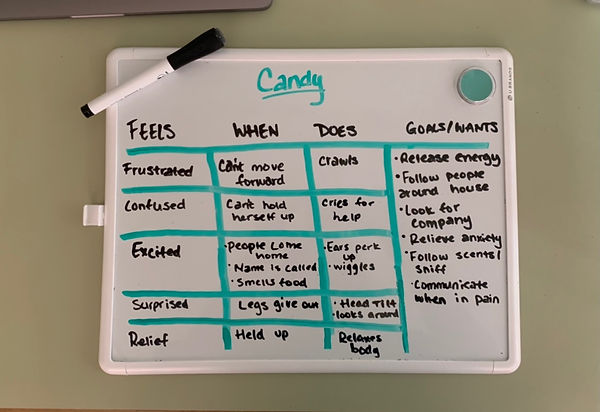
Doggy Empathy Map
I also created an empathy map that highlighted her needs and restrictions. I wanted my solution to alleviate any discomfort she had but also allow her to express herself and complete her doggy goals
BRAINSTORMING
WORD ASSOCIATION
I had a lot of images and information in my head. I decided to do a word a short brainstorming session where I wrote Candy's name on my small whiteboard and gave myself 5 minutes to write down whatever came to mind
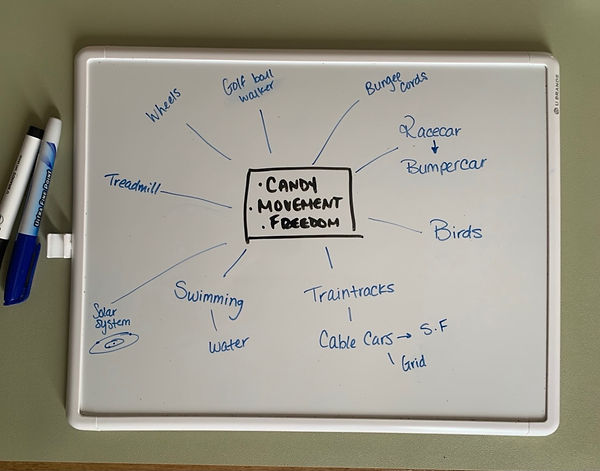
Idea 1- Cable Cars
I knew Candy was able to walk if she was held up by her harness. I thought I might be able to create a track in my house and attach her harness to it, similar to a cable car.
Pros
-
A set path would prevent her from walking into walls
-
Utilizes her harness, which she's already comfortable with
-
Cost effective- wall divider tracks are pretty cheap and easy to install
Cons
-
Can't be used outdoors
-
I would have to install tracks all over the house
-
Can't really seamlessly walk into different rooms
Idea 2- Swimming
My idea was to add long waddle pools all throughout the house, so she could walk around the perimeter of the house while inside the pool (while wearing her life vest, of course)
Pros
-
Being in water would be great physical therapy, and could build muscle
-
Candy likes being in water
Cons
-
Can't be used outdoors
-
Would be very expensive
-
A lot of upkeep
-
Slightly dangerous
Okay, I'll admit: maybe this idea was a little out there
Idea 3- Bumper Cars
A cart that supports all of her weight, while allowing whichever set of paws do the moving
Pros
-
If her full weight is supported, she could use it while her front legs aren't working or vice versa
-
Ability to freely roam the house
-
Can be used indoors and outdoors
-
Cost effective
Cons
-
Anything on wheels could increase the chances of bumping into things
-
Building materials could be heavy
Prototype
MATERIALS
I decided to build my first cart out of PVC pipe because it was lightweight, easy to cut, and I knew I could attach wheels to it. I created the sling that would carry her out of fabric from a Kuranda bed, since I knew it was a dog friendly material. The sling was attached to the frame by heavy duty velcro, so it could be adjusted


Issues
Candy was very excited to use her walker, but the back wheels spun in an unnatural way which caused her to bump into things. This walker was also a bit heavy, and didn't allow her to move past sidewalk bumps.

ITERATION
I created a new cart out of thinner PVC pipe, and attached a halo out of bouncy aluminum wire, covered in baby proof foam
Issues
This cart was too light weight, and sometimes came apart if Candy walked fast enough. The walker was also too wide, which didn't let her walk in a natural way. Lastly, the back wheels swung around a lot, so any step she took in one direction was over exaggerated
ITERATION 2
I created a third cart, made out of 1 inch PVC pipe. The body was thinner, and I welded the back castor wheels so they couldn't move freely, only back and forth. Lastly, I added an extended pole in the front of the walker, to help with her habit of leaning towards the left

At the moment, Candy uses all three carts. The first cart built is used for outdoors, since it's the sturdiest. The second iteration is used when she's tired, since she's more prone to bump into corners and it's easier to walk in. Her red cart is used daily, when she has the most energy
IMPACT
Zelda
After seeing Candy on social media, a dog mom reached out to me about Zelda, a two year old dog with neurological and spine issues. Zelda had a regular dog wheelchair but it didn't help her. After a lot of iterations and doggy kisses, Zelda received a cart that was tailored to her small body.

If you have a handicapped pet and need a wheelchair, or the directions and links to the materials I used, feel free to reach out!